
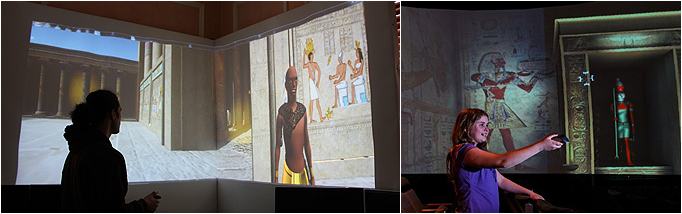
Gates Of Horus
"Gates of Horus" is an educational game based on the Virtual Egyptian Temple. During play, the user has a question-and-answer dialogue with a (virtual) Egyptian priest regarding the temple's major features and their meaning. each time the player demonstrates sufficient knowledge of one area of the Temple, the next gateway opens, allowing the player to go deeper inside. The goal is to reach the inner sanctuary and unlock the final mystery.
Gates of Horus is intended for one player and takes 45 to 90 minutes to play, and runs on a standard desktop computer. The game begins with the help screen, which describes basic play and navigation. For more detail, you can read the game rules.
The game works equally well in a "Corner Cave" display, shown in the image above, left. It is a simple arrangement where two projectors are plugged into one computer, to display on two screens at a 90-degree angle. The perspective correction in the images creates a unified panoramic view for the user. It will also work in a digital dome. In our largest learning study, to date, we found evidence that students playing the game in a dome learn more than those playing on the desktop (Jacobson, 2011).
Publications
Jacobson, J. (2013) Digital Dome Versus Desktop Display; Learning Outcome Assessments by Domain Experts, International Journal of Virtual and Personal Learning Environments, Fall, IGI Global (in press). PDF
Jacobson, J. (2011) Digital Dome Versus Desktop Display in an Educational Game: Gates of Horus, International Journal of Gaming and Computer-Mediated Simulations (IJGCMS), special issue on educational applications, Spring, 2011, IGI Global. PDF
Jacobson, J. (2008) Ancient Architecture in Virtual Reality; Does Visual Immersion Really Aid Learning? Dissertation, School of Information Sciences, University of Pittsburgh. PDF